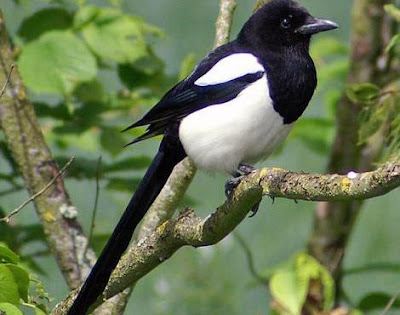
The magpie has many characteristics to admire.
Magpies mate for life,
sharing the domestic duties of nest building and feeding and raising their
young. After laying six to eight eggs, the female magpie incubates the clutch
for 16 to 21 days. Both parents are attentive to the nestlings, and they fledge
when 25 to 29 days old. Magpies raise a single brood each year. They build their
nests in loose colonies, keeping their siblings and young close.
Graceful in flight, these large members of the crow family are long tailed,
black and white birds, approximately 20 inches in length. In the soft sunlight,
their black wings and tail appear iridescent bluish-green in bold contrast to
gleaming white wing patches.
Magpie nests are large for the size of the bird - often measuring in excess
of three feet across. The nest is a spherical mass of sticks and twigs, often
adorned with found bits of colorful thread, paper or string. Built for comfort
with a mud cup lovingly lined with soft wool, hair or moss, the nest also has
side entrance holes. They nest in bushes and trees at low elevations 10 to 20
feet from the ground.
Like other corvids, magpies are omnivorous and opportunistic. Small
rodents, other birds, bird eggs, snakes, insects, berries, nuts and seeds are
favorite fare. Magpies are not picky eaters. Magpies are not timid and can be
trained to feed from the hand. In their brave journey across Montana, this
behavior was mentioned by Lewis and Clark in the chronicles of their adventures
in 1804.
Magpies serve a very important purpose in nature in that they consume large
quantities of ticks gleaned from the bodies of deer, bison, moose and elk,
especially in the early spring. Ticks are a tiresome irritation to the host
animals, so they most willingly submit to the magpies grooming attention.
Historically, magpies frequently followed Native Americans and lived on the
refuse of their hunts. A born thief and scavenger, magpies will also often
follow predators to clean up after their kill, feasting on maggots as well as
carrion. Native American folklore tells of the magpie leading the wolf to
wounded or weak prey so that the wolf may finish the kill and together they may
feast on the bounty.
Because of their aggressive intelligence, year-round residency and handsome
plumage, magpies have long been admired favorites. In early Indian tribal lore,
a warrior who wore two magpie feathers woven in his hair was considered both
fierce and fearless. The magpie also features prominently in many Indian myths
and legends as both a doer of good deeds as well as a crafty mischief-maker.
A pair of Magpies nested in a neighbour's tree in 1998, after much fighting
between rival pairs. The nest building took several attempts over six weeks, and
when finished did not have a domed roof. Given the time it took to build, and
the absence of the roof, we think they were an inexperienced couple. We never
saw the juveniles, so we do not know whether they were successful in rearing
young. The gales at the beginning of February 1999 demolished the previous
year's nest, but the Magpies started to rebuild it during March and April, but
after several failed attempts they gave up and flew away. They nested somewhere
close by and the bird with the passion for dunking its bread was a regular
visitor. The Magpies' attempts to build a nest in 2001 - 2004 were abandoned
after continued attacks by Carrion Crows. In 2005, they nested successfully in a
neighbour's tree, but the juveniles were not seen.
Many winters ago the people received a gift called the talking feather. I
will share with you the story of how this came to pass. When the call came to
the young mothers in the village to take their baskets and gather the fruit and
berries, the old grandmothers, whose legs had lost the fast walk and sure foot
of the doe, were left to care for the young children. The mothers honored the
grandmothers by giving them this responsibility on those days.
It is believed that the young children have many dreams and visions to
collect before they are grown. They were given a bit of sleep in the warmth of a
darkened lodge before Sun has traveled his full path each day. Now let me tell
you what happened on one of these days.
Crow and Magpie, two of our noise making winged ones were having a terrible
argument outside the lodge of the sleeping children. "Caaaw-caaaw" screamed
Crow. "Kaaack-Kack" yelled Magpie. They were both speaking at once and they
could not hear each other's point of view on the subject of which tree belonged
to which bird.