Saturday, December 5, 2015

Smart Birds Make the Worst Parents

After patching up the hawk mount I continued my experiment, but I also wanted to know how both parents responded to a predator after having invested even more in their offspring. Since both parents feed their chicks, I conducted similar trials once the chicks had hatched and the parents were feeding them as nestlings. I found that both when parents were incubating, and when they were feeding their nestlings, they were hesitant to enter their nests in the presence of these ‘hawks’. However, the parents responded differently depending on how far up the mountain they lived. If they were from high elevation, the parents were much more likely to be scared away by the ‘hawk’ predator.


To find out whether chickadees that live high up behave differently in response to predators, I carried out an experiment. To do this, I placed a tripod at the entrance to a nestbox and scrambled away to become one with a distant pine tree, while keeping my binoculars trained on the recently departed female and the nest. When the female returned, what did she do? The mother stopped short of the nest area, rather than ‘bird’-lining it straight for the entrance. She was agitatedly hopping from branch to branch scolding the hawk for being near her nest. She flew off, only to return later. Eventually, she entered the box to make her eggs hot.


How might these unexpected results be explained? One possibility comes from a study on a closely-related English bird called the Great Tit (leave it to old English men). Ella Cole and her colleagues found that parents who were better at solving a novel problem were also more likely to abandon their offspring when disturbed. High elevation chickadees, like their problem-solving cousins, have superior cognition compared to their less smart low elevation counterparts. Mountain Chickadees use food-storing as a way to survive winter. Since high elevation chickadees contend with harsher environments, they have superior spatial memory than low elevation chickadees, allowing them to recover enough stores to survive more severe winters. So, could it be that there is some kind of trade-off between being smart and being willing to take a risk? The reason behind these results remains intangible, but maybe smart individuals just make poor parents.

Tuesday, November 24, 2015

Let's talk about birds

It’s that most wonderful time of year when the word “nutcracker” enters into conversations again, and mostly because of the title character in a fanciful holiday ballet. In the story, the Nutcracker is not a bird, but there are birds that are nutcrackers.

20151125HOMacaw2-1 Green-winged macaw.

In fact, there are two birds, both members of the crow family, named nutcracker. The Clark’s nutcracker is found throughout the high mountains of western North America; the spotted nutcracker lives in the mountains of Eurasia, including the Himalayas. Both of these birds feed primarily on pine “nuts,” the hard seeds found inside pine cones. Their long, strong bills enable them to extract the seeds from in between the stiff scales of pine cones.

Other avian nutcrackers are the macaws, large members of the parrot family. The birds’ name, macaw, comes from an indigenous South American word for palm nut. Macaws are among the few animals capable of cracking very hard-shelled palm nuts to feed on the high-energy oily nut meats inside. Their formidable nut-cracking ability is thanks to their very tall, stout, hooked beaks and their strong jaw muscles, which enable them to exert a maximum bite force of up to 2,000 pounds per square inch — 10 times that of a human and twice that of a snapping turtle. Only crocodiles can bite as hard as a macaw, but they don’t like nuts.

At this time of year, people often put out bowls of nuts in the shell for holiday gatherings. It is nearly impossible for anybody to crack them with their bare hands or teeth, though, so if we want the nuts to be more than just decoration, we will make sure there is a mechanical nut cracker and nut pick nearby. But, if our guests were large macaws, they could easily help themselves, exerting the bite force needed for cracking even the hardest nutshell, and then using their nimble feet and pointed beak to deftly extract every little bit of nut meat.

Friday, November 6, 2015

From starving chicks come fat birds

Dr Andrews, of the Newcastle University Centre for Behaviour and Evolution said: "Building up body fat reserves as a safeguard against times of potential future famine is an evolved survival mechanism. What we have shown is that birds that had struggled against larger brothers or sisters for food early on were keener on finding food and tended to overeat when they became adults".

From starving chicks come fat birds

To ensure that some birds were disadvantaged by experiencing greater competition, smaller starling chicks were placed in a brood with significantly larger hatchlings. These chicks had to work harder than their siblings to be fed, spending more energy on calling to their parents for food and jostling to the best feeding position.

Dr Andrews explains: "The smallest chicks were bottom of the heap and had a tougher time because they would have had to beg hardest for food."
These disadvantaged chicks were compared with birds that were placed in broods with significantly smaller chicks. After ten days, disadvantaged and advantaged chicks all lived together in relative luxury so that it was only their 'chickhoods' that differed.

Birds that had a tougher start spent more time searching for hidden crumbs despite the ready availability of alternative sources and ate more of the freely available crumb when they accessed it. The birds that had an easier start, having been the largest in the nest, opted instead to take the easy pickings in moderation.
The scientists suspect that the birds with a tougher start, the disadvantaged starlings, were behaving as if they were worried food might run out suggesting that they have a 'memory of hunger' from when they were small which drives them to overeat when presented with freely available food.

Saturday, October 24, 2015

Birds and climate to be discussed in Lakeville

Audubon Minnesota, Conservation Minnesota, and Lakeville Friends of the Environment will present the Audubon Bird Impact Study and discuss future impacts on Minnesota birds 6:30 p.m. Tuesday, Oct. 27, at the Lakeville Heritage Library, 20085 Heritage Drive.


Based on a recent bird impact study released by Audubon Minnesota last fall, 166 bird species commonly found in Minnesota are at great risk. Audubon’s scientists analyzed more than 30 years of historical North American climate data and tens of thousands of historical bird records from the U.S. Geological Survey’s North American Breeding Bird Survey as well as utilized information from the Audubon Christmas Bird Count to understand the links between where birds live and the climatic conditions that support them. Understanding these links allow researchers to project where birds are likely to be able to live and thrive in the future.

How many of our current bird species will be here in 20 years? What new species might move into the state from the south? Researchers predict changes are certain. We’ll lose species, boreal nesters in particular, as they follow their breeding climate north. Bird species now found to our south will enter Minnesota for the same reason.

This is one of those topics easily dismissed as far in the future. Not true. Birds are at risk more and more each day. A story in The New York Times today (Friday, Oct. 23) predicts that when the carbon dioxide content of our atmosphere returns to 400 parts per million this winter, it will never again be less. It will only climb. Seasonal change based on summer vegetation causes the measurement to vary slightly; it dropped a few weeks ago from over 400 to just under. It was at 398.48 on the 23rd.

Tuesday, October 13, 2015

Bird lovers fear annual Australian back yard count will detail species' decline

BirdLife Australia’s state of Australia’s birds report in July found magpie, kookaburra, lorikeet and willie wagtail numbers are declining.

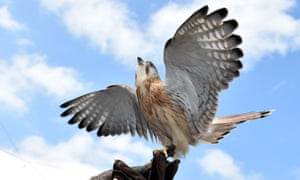
Nankeen kestrel

Gazing at large numbers of birds darting overhead may not be ideal for people with Hitchcockian fears but the steady emptying of Australian skies of some species is getting twitchers a little, well, twitchy.

The annual Aussie back yard bird count swooped into action in Melbourne’s Federation Square on Tuesday morning with the expectation that some worrying declines in some of Australia’s most common birds will be confirmed.

BirdLife Australia’s state of Australia’s birds report, released in July, found that well-known species such as the magpie, kookaburra, lorikeet and willie wagtailwere dropping in numbers across large parts of the country.

The backyard count, which encourages people to step out of their house for 20 minutes to count birds, is a less rigorous exercise. Last year’s effort included reports of penguins in the Murray river, after all.

But the count is expected to highlight the level of concern over Australia’s birds that recently prompted a federal government plan to save some of the most threatened of our feathered friends, including the helmeted honeyeater and the night parrot.

The concrete-slathered Federation Square may not be a birders’ paradise but even here a total of seven species were spotted in 20 minutes, including – of course – the rock dove, or pigeon.

The highlight was probably two bright flashes identified as lorikeets by the experts at BirdLife Australia as handlers fed two celebrity birds – Min Min the one-eyed barn owl and Kevy the nankeen kestrel – perched on gloves. Children happily scribbled colours into outlines of hawks and eagles on paper.

Wednesday, September 23, 2015

Migratory birds make journey from Alaska to Adelaide for summer vacation

Thousands of birds have begun arriving at the salt marshes, mangroves and mudflats along Adelaide's northern coast as part of their annual migration.
About 27,000 birds call the area home each summer with many making the journey from as far away as northern Asia and Alaska.

red-capped plovers

The South Australian Government bought the 60-kilometre stretch from the Barker Inlet to Port Parham, some 2,300 hectares, in August last year to turn into a bird sanctuary.

Proclaimed as the Adelaide International Bird Sanctuary, the Government has committed to invest $1.7 million to the project.

Birdlife Australia has been monitoring the shorebird population in the Gulf St Vincent for the past eight years to identify how best to protect the environment to ensure the 200 species continue to make the journey every year.

Research and conservation officer Chris Purnell said there had been a staggering decrease in shorebird numbers over the past 45 years.

Many of the birds travel more than 11,000 kilometres to reach the South Australian coast, along the East Asian Australasian Flyway, and depend on the area to fatten up for the long journey back to their breeding grounds.

But Mr Purnell said conservationists faced an up-hill battle in protecting the environment, particularly from damage caused by four-wheel driving enthusiasts.

Groups unite to protect bird population

Members of 30 different organisations have banded together to lead the establishment of the Adelaide International Bird Sanctuary.

The group, which goes by the name The Collective, consists of representatives from the Kaurna community, local and state government and the tourism industry, as well as bird experts, university leaders, school students and members of the Vietnamese Famers Association.

The group is also discussing the possibility of establishing camping areas within the sanctuary for avid bird watchers.